Why some AMD streams run white instead of orange
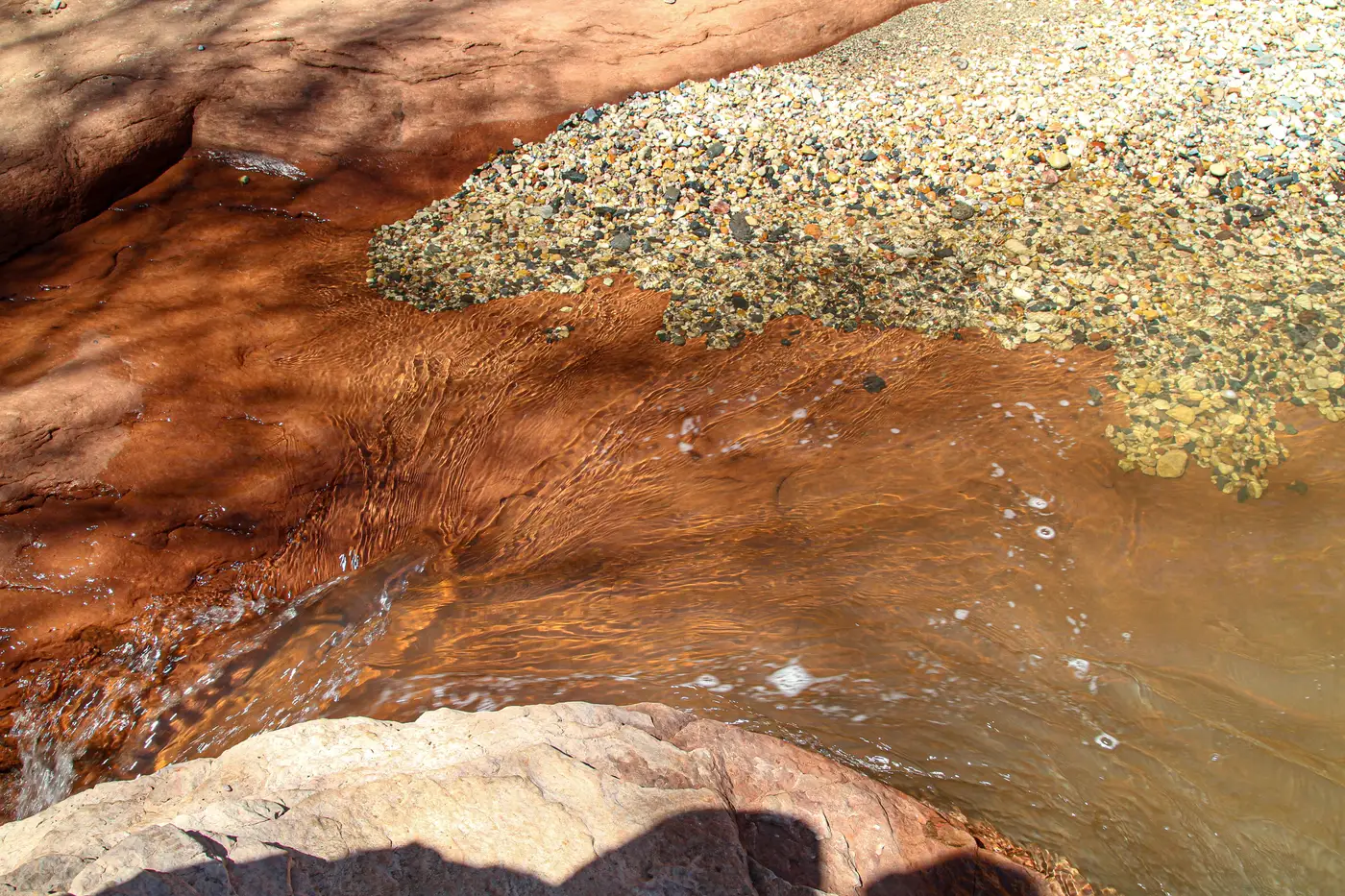
Most people who've spent time walking a watershed with legacy workings upstream know the orange on sight. Ferrihydrite staining the streambed rust-red to ochre, the classic "yellow boy" tell of iron-bearing acid mine drainage. So when a reach runs milky white or pale gray instead, it throws people off. The explanation is straightforward: a different metal is falling out of solution, and it's doing so at a different point on the pH curve than iron does.
Iron drops out first, at a lower pH
Dissolved ferrous iron oxidizes to ferric iron on contact with air, then hydrolyzes and precipitates as ferrihydrite (and eventually goethite) starting around pH 3.5, with most of it out of solution by pH 4 to 4.5. That's a narrow, early window, which is why orange staining often shows up fast, sometimes within a few hundred meters of a seep or discharge point, before the water has had much chance to buffer.
Aluminum waits for a higher pH
Dissolved aluminum stays in solution across a wider range and doesn't start precipitating as aluminum hydroxide (gibbsite in theory, though what you actually see in the field is usually the more amorphous hydrobasaluminite) until pH climbs into roughly the 4.5 to 5.5 range, depending on sulfate concentration and temperature. Where a stream buffers up to that level, aluminum comes out as a flocculent white-to-pale-gray precipitate instead of ochre. It's the same basic hydrolysis-and-precipitation process as iron, just triggered later in the pH recovery.
So why is the water white instead of orange
A few things produce this, and they're not mutually exclusive:
- Iron already settled out upstream. A pond, wetland, or earlier confluence can strip most of the iron load before the water reaches your sample point, leaving aluminum to drop out further downstream with nothing left to color it orange.
- The source water is aluminum-dominant. Some coal-measure drainage and some metal-mine discharges carry more dissolved aluminum than iron from the start, so there's never much ochre to begin with.
- You're standing in a transition zone. Walk downstream from an orange reach and watch the pH climb: iron drops first, aluminum drops a bit further along, and the stretch in between often runs a dirty cream color as both precipitates mix.
Manganese isn't the explanation here. It stays dissolved until pH climbs to around 8.5 or 9, well above what most AMD-affected streams reach, so it rarely contributes visible solids at ambient conditions. A white or pale precipitate is reliably an aluminum signature, not a manganese one.
Why the color matters for screening
Color is a fast field proxy, and it's a lopsided one. A reach can be carrying a full aluminum load with no orange anywhere in sight, because the iron already settled out a kilometer upstream. Screening by eye for ochre alone will miss that reach entirely, and on paper it reads as clean.
That gap is part of the case for watershed-scale imagery screening rather than spot-checks at the sites known to run orange. A monthly pass over the full watershed catches the pale, aluminum-dominant tributaries too, not just the visibly rust-colored ones, which matters when the deliverable is a flagged-pond and plume-extent layer rather than a handful of grab samples. If you're screening a watershed and want both the ochre and the paler signatures covered in one pass, that's the use case Mine Water Quality is built around, and it's worth a look at what a pilot on your watershed would cover.