Iron fen or AMD plume? Reading ochre signatures in satellite imagery
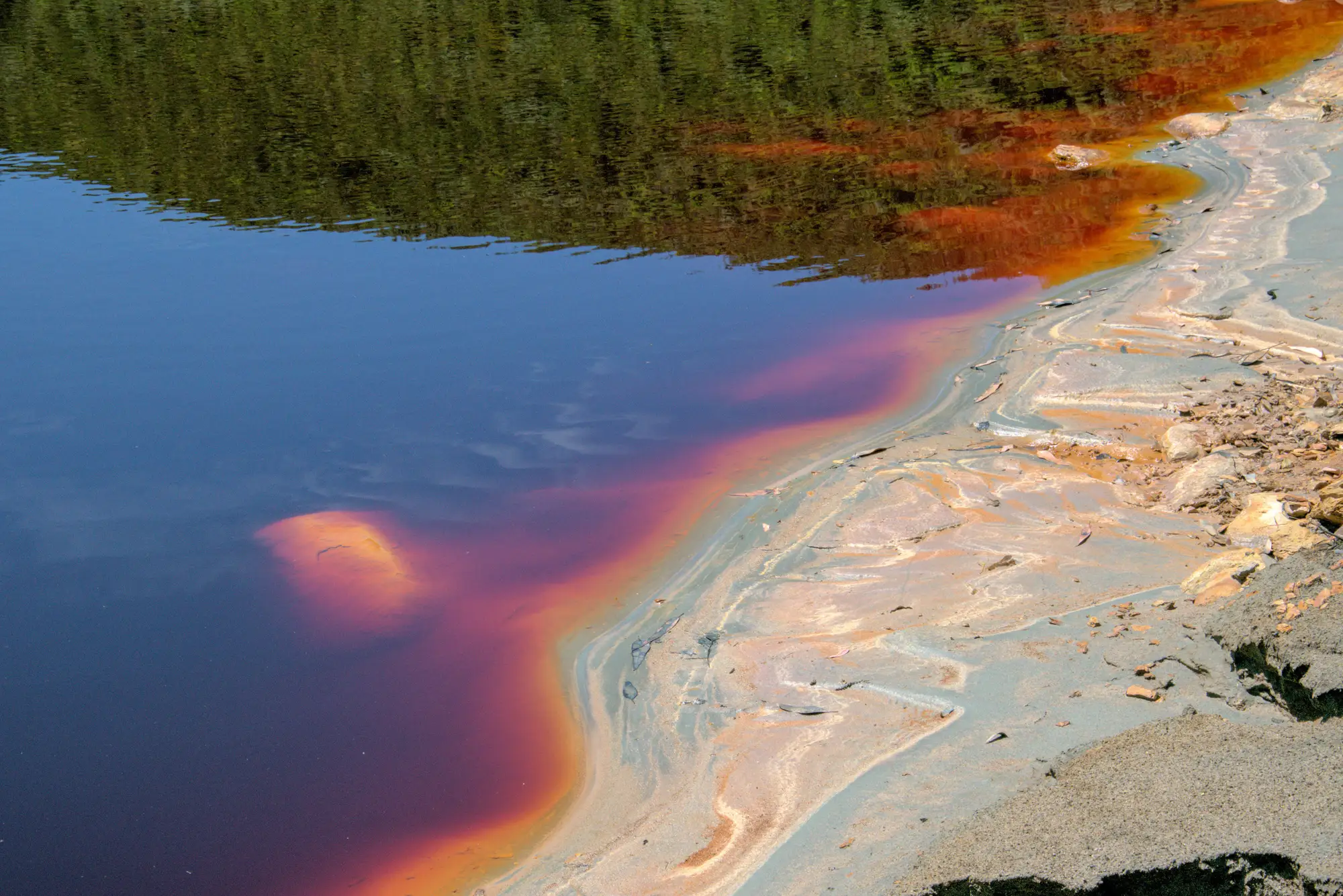
Ochre shows up in a lot of places that have nothing to do with a mine. Before you write up a suspected AMD plume for a watershed screen, it helps to know what else paints a wetland that color.
What makes the orange color in the first place
Both signatures come from the same basic chemistry: dissolved ferrous iron reaching oxygen, oxidizing, and dropping out as iron oxyhydroxide, usually ferrihydrite or goethite. That's the ochre you see from above, whether it's sitting in a bog that's been doing this since before anyone drilled a hole nearby or in a settling pond below a waste rock pile. The mineral is the same. The source and the setting are not.
A natural iron fen forms where groundwater carrying dissolved iron discharges at a seep, usually in a peatland or spring-fed wetland sitting on iron-rich glacial till or bedrock. No mine required. Bog iron deposits like this were mined by hand in parts of the Northeast and Upper Midwest long before anyone was pulling ore out of a shaft. The staining is a feature of the hydrology, not a symptom of a discharge.
Four things that actually tell them apart
Where it sits relative to workings. An iron fen doesn't care where the nearest adit is. It sits wherever the groundwater geochemistry and the wetland line up, which can be miles from any disturbed ground. An AMD signature, by contrast, almost always has a traceable upstream point: a tailings impoundment, a waste rock pile, an adit or shaft collar, a pit lake. If you trace the ochre upstream and it dead-ends at an undisturbed spring rather than a mine feature, that's a strong vote for natural.
Shape and edge. Iron fens tend to read as diffuse, mottled patches spread through sedge or moss vegetation, because the iron is precipitating slowly across a broad seep zone and settling among plants rather than concentrating in open water. AMD plumes more often follow a channel: a tight, linear or fan-shaped trace running downslope or downstream from a single source, sometimes widening where it hits a wetland or low-gradient reach but still showing a clear upstream apex.
The turquoise tell. This is the one most worth remembering. Acid mine drainage frequently carries the water low enough in pH that you get a secondary signature alongside the ochre: a turquoise or milky-blue cast in standing water, from suspended aluminum hydroxides and fine clay colloids that don't settle the way iron does. Iron fens, sitting at near-neutral pH, essentially never produce that turquoise companion. If you've got a pond or pool showing both an ochre fringe and a turquoise center, that pairing is a much stronger indicator of mine-influenced water than ochre on its own.
Seasonal behavior. A natural fen holds a fairly stable signature month to month, since it's driven by a steady groundwater seep. An AMD source tied to active workings can intensify after a heavy rain event flushes a waste rock pile, or shift with mine dewatering schedules and seasonal water table changes. A plume that brightens sharply after a storm and fades over the following weeks points toward a mine-site hydraulic response rather than a steady natural seep.
None of this replaces a sample bottle
Spectral signature reading narrows down where to send a field crew. It doesn't substitute for the conductivity meter, the pH strip, or the lab panel on dissolved metals. What it does is keep you from running a sampling campaign across every ochre patch in a watershed when half of them are bog iron that's been there since the last glaciation retreated. Cross-reference against known iron fen or peatland inventories for the basin if your state or province keeps one, because that alone resolves a lot of ambiguity before you ever leave the office.
If you're screening a multi-site watershed and don't want to chase every orange patch on foot, Mine Water Quality runs a monthly spectral pass over the basin and flags ponds and downstream plumes worth a closer look. Get in touch if you want to pilot it on your watershed.