What acid-base accounting tells a permit reviewer
Every mine permit file that crosses a reviewer's desk eventually gets to a table of numbers: total sulfur, paste pH, neutralization potential, net acid-producing potential. That table is the acid-base accounting, and it's doing one job. It's trying to predict, years before a single rock is moved, whether the waste rock and tailings at a site will end up generating sulfuric acid once they're exposed to air and water.
What ABA is measuring
Acid-base accounting is a static test. A lab takes a representative sample of the rock that's going to be mined, or the waste that's going to be stored, and runs two numbers against each other.
The first is maximum potential acidity (MPA), calculated from total sulfur content on the assumption that the sulfide minerals in the sample, usually pyrite, will eventually oxidize completely. The second is acid neutralizing capacity (ANC), which measures how much carbonate and other buffering mineral the same sample has to work against that acid once it forms. Subtract one from the other and you get net acid-producing potential, NAPP. A positive NAPP means the rock is predicted to generate more acid than it can neutralize on its own.
Static testing is cheap and fast compared to the alternative, which is running kinetic humidity-cell tests for months or years to watch oxidation happen under lab conditions. ABA doesn't tell a reviewer what will happen on site, with site-specific rainfall, grain size and exposure. It tells them which rock units are worth worrying about and which aren't, so the kinetic testing and monitoring budget gets pointed at the right material.
The net acid generation (NAG) test is the field's way of checking the static number against something closer to reality. A sample gets treated with hydrogen peroxide to force rapid oxidation, and the pH of the resulting leachate is measured directly. If NAG pH comes back low and acidic even after the peroxide reaction settles, that's a stronger signal than NAPP alone, because it's measuring an actual acid-forming reaction rather than inferring one from sulfur content. Most permit applications that take acid rock drainage seriously will show NAPP and NAG side by side, because they can disagree, and a reviewer wants to see both before deciding a material is safe to store in an unlined pile.
Why permit reviewers ask for it specifically
A permit decision has to hold up for the life of the mine and well past closure. Acid mine drainage doesn't usually show up in month one. Pyrite-bearing waste rock can sit stable for years before the acid-generating reaction gets past whatever neutralizing capacity was buffering it, and by the time it does, the plume is already moving into a creek or a shallow aquifer. ABA is the tool that lets an agency ask "is this waste rock a problem" before the mine exists, rather than after a tailings facility is already leaching.
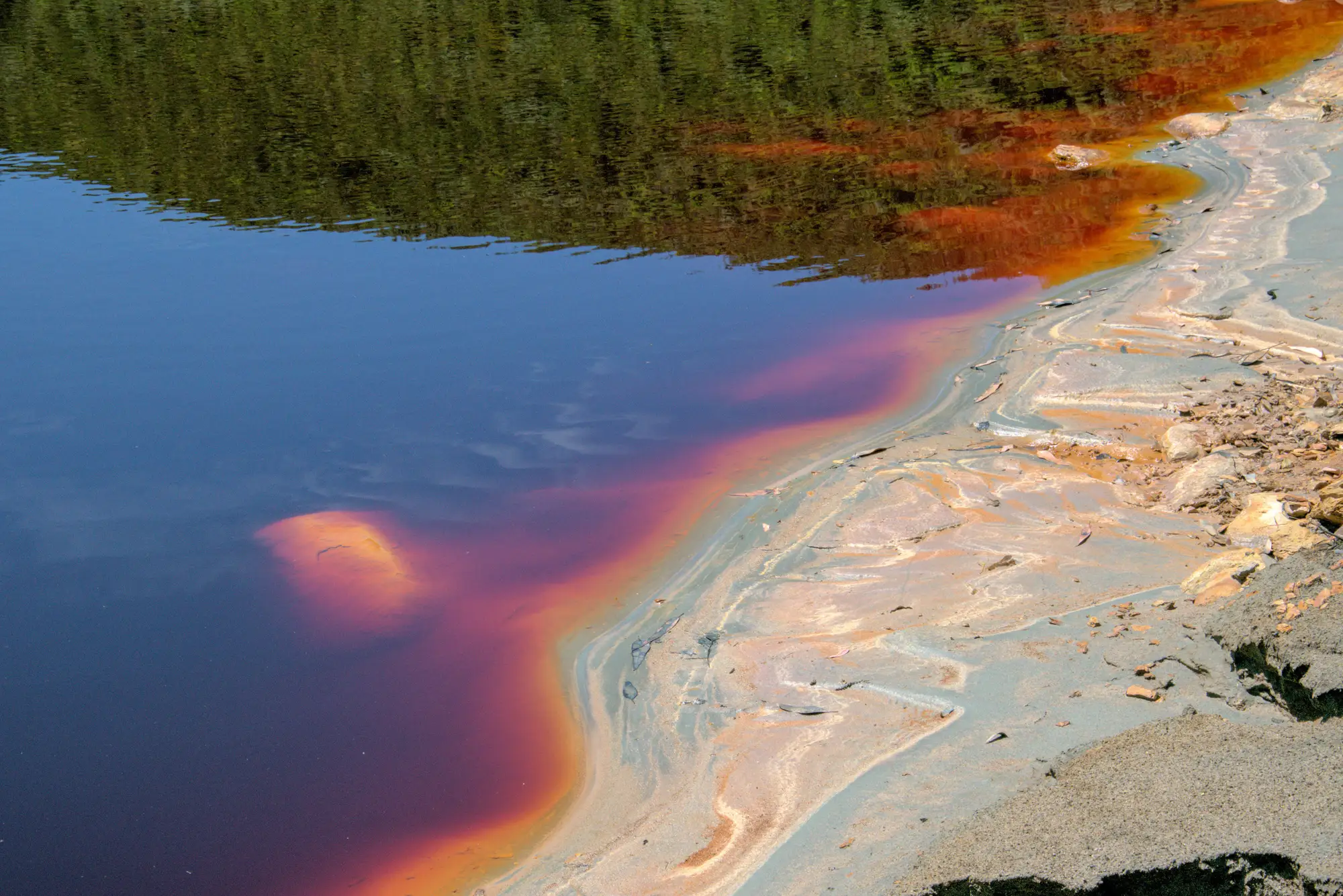
That's also why ABA alone rarely satisfies a thorough review. The test measures a sample's behavior under forced lab oxidation. A specific waste rock dump has its own drainage path, climate and exposure history, and those conditions decide what actually leaches off it. A site can look fine on paper, net neutralizing on every borehole sample, and still produce a visible ochre stain on a downstream pond two years after the first lift goes down, because the geochemistry in the file and the geochemistry on the ground aren't the same test.
That gap is the reason a watershed-level screen matters alongside the permit file. Static testing at the sample stage and a standing check on the ground, further downstream and over time, aren't substitutes for each other. One predicts what rock should do. The other shows what a pond or a stream reach is doing, month over month, across every site in a watershed rather than the one under review. Mine Water Quality runs that second check from wide-swath multispectral imagery, flagging the ochre and turquoise spectral signatures of contaminated ponds and tracing how far a plume extends downstream, without a sampling crew driving between every legacy and active working.
If you're reviewing a permit file full of NAPP and NAG numbers and want to know what's visible on the ground across the whole watershed those numbers sit in, that's the gap this screen is built to close.